

Naperville Estate Planning Lawyer Discusses Handwritten Wills

For most people, a last will and testament is one of the most important documents they will ever create. Your will likely contains provisions that dictate how your assets are to be divided among your chosen beneficiaries, but there are many other considerations that may also be included. You can use your will to establish guardianships for your children and make arrangements for heirs who may not be capable of managing their own affairs. You will also name an executor to manage your estate and to oversee the distribution of your assets in your will.
However, many questions arise when people attempt to draft their will. What happens with a will that is not prepared by an attorney or one that is handwritten by the will’s creator? Is a handwritten will valid in the state of Illinois? In my practice as an estate planning lawyer in DuPage County, I have prepared wills for countless clients as they look to secure the future for their loved ones. I take every precaution to ensure each will is properly witnessed, signed, and otherwise created in accordance with Illinois law.
Handwritten Wills and the Law
The validity of a will in Illinois is determined by the Probate Act of 1975 (755 ILCS 5/). The Probate Act provides that a valid will must be in writing and signed by the will’s creator—known as the testator—or another person in the testator’s presence at his or her direction. At least two witnesses must attest to the signing of the will. If one of the witnesses — or a witness’s spouse — is a named beneficiary in the will, two other witnesses must attest the signing.
The testator must be at least 18 years old and have the capacity to understand the terms and conditions of the will. The law does not refer to how the will must be created other than that it must be written. A handwritten will meets the definition of a written will as far as the law is concerned. This means that any will that is properly signed and witnessed is valid. A handwritten will that is not witnessed is known as a holographic will and is not valid under Illinois law.
This can come as an unwelcome surprise to families who discover too late that a loved one’s handwritten wishes may not hold up in probate court. Understanding when a handwritten will works, and when it does not, is essential for avoiding disputes and ensuring your estate is distributed the way you intend.
Why Purely Holographic Wills Are Not Valid in Illinois
A purely holographic will is not valid in Illinois because Illinois law requires all wills to be signed in the presence of at least two witnesses. The witnessing requirement is the primary reason a holographic will might not be valid in Illinois. A purely holographic will is defined as being written entirely in the testator’s handwriting and is typically unwitnessed. Without witnesses, a handwritten will is considered invalid and cannot be admitted to probate.
A purely holographic will may be poorly written, contain errors, or be ambiguous, which can create challenges during probate, even when properly witnessed. Yet a handwritten will that is properly witnessed and meets the exact requirements as a typed will (signed by the testator and witnessed by two people) may be legally valid. If a person moves to Illinois and has a legally valid handwritten will from a state that does not require witnesses, Illinois courts may or may not recognize it.
Possible Complications of a Handwritten Will
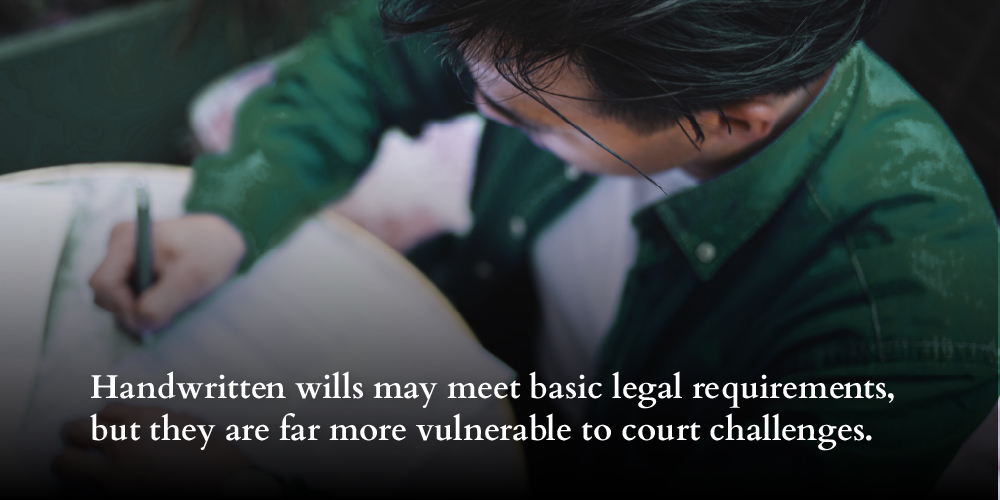
While a handwritten will may be valid, there are several reasons it may not be ideal. Most importantly, a handwritten will suggests that the testator developed the document without the guidance of a legal professional. The will, therefore, could contain errors, provisions that are not enforceable, and decisions that could be challenged down the road.
Complications with an Illinois handwritten will can include legal challenges due to misinterpretation, questions about the testator’s mental capacity, or a lack of proper witnesses, causing the will to be declared invalid. If a handwritten will is declared invalid, the estate will be distributed according to state law, rather than the decedent’s wishes. Even a testator’s illegible handwriting and the potential for mistakes in legal wording can be costly and time-consuming to resolve in court, and may require the services of a handwriting expert.
A poorly-worded handwritten will can be interpreted in different ways, leading to family disputes and court battles over the testator’s true intent. Interested parties can challenge a handwritten will by questioning the testator’s mental capacity, claiming the testator was under duress, or arguing about the authenticity of the handwriting. A handwritten will is also more likely to overlook important details like providing for alternate beneficiaries, naming guardians for minor children, or addressing new assets acquired after the will was written.
A person looking to save money on hiring an estate planning lawyer is more likely to make mistakes that may not become evident until long after his or her death. However, these issues relate more to the contents of the will than its format. A will cannot be declared invalid simply because it was handwritten as long as all of the legal requirements for a will are met, but it does open the will up to more challenges and a more complex probate process.
How to Avoid Complications When Making a Will
An experienced estate planning attorney can help ensure that a will is clearly written, legally valid, and free of ambiguities. This can help prevent future complications and potential lawsuits. A professionally drafted will is much more likely to withstand legal challenges, particularly when it is properly executed, according to Illinois law.
Let a Naperville, IL Estate Planning Lawyer Review Your Handwritten Will
If you have prepared a handwritten will, it is advisable to have it reviewed by an experienced Naperville estate planning attorney from the Gierach Law Firm to ensure that it is valid. Our team can also help you identify any potential concerns and prevent them from causing real problems for your family in the future. Call the Gierach Law Firm at 630-756-1160 for a confidential consultation today.
Practice Areas
Archive
+2016
+2013
Please note: These blogs have been created over a period of time and laws and information can change. For the most current information on a topic you are interested in please seek proper legal counsel.
Blog Sign Up
Like what you see?
Follow us to stay current!


630-756-1160

CONTACT US
Providing You With
Peace of Mind






400 East Diehl Road, Naperville, IL 60563 |
630-756-1160

